Smooth Nasolabial Creases
Using the Nuvicor device to reduce the Nasolabial fold — TRAINING THE ZYGOMATIC MUSCLES

Nasolabial Fold Elimination: Zygomatic Muscle Training
The Cause of Nasolabial Folds
Two facial muscles play the primary role in the formation of nasolabial folds: the zygomaticus muscle
and the levator labii muscle (Fig. 1). As we age, these muscles weaken, just like all other muscles in our body (a process known as physiological sarcopenia).
and the levator labii muscle (Fig. 1). As we age, these muscles weaken, just like all other muscles in our body (a process known as physiological sarcopenia).
Over time, muscle volume decreases, but the ligaments that anchor these muscles remain in their original positions. Because of this, as the muscle loses volume, its ligaments become increasingly taut.
Both the zygomaticus and levator labii muscles attach at their lower ends (via tendons) to the orbicularis oris muscle (the muscle surrounding the mouth). Due to this constantly increasing tension on the tendons, the skin in the nasolabial area begins to pull upward and outward. This is precisely what triggers the formation of nasolabial folds.

Figure 1
Furthermore, as these muscles weaken, they gradually lose their ability to support pockets
of subcutaneous fat (fat compartments, shown in Fig. 2). As a result, the subcutaneous fat begins to sag under its own weight—a process called gravitational ptosis. As the subcutaneous fat shifts downward, it forms rolls of skin that hang over the nasolabial fold.
of subcutaneous fat (fat compartments, shown in Fig. 2). As a result, the subcutaneous fat begins to sag under its own weight—a process called gravitational ptosis. As the subcutaneous fat shifts downward, it forms rolls of skin that hang over the nasolabial fold.
This combined process is what creates a characteristically aged facial appearance.

Figure 2
How to Counteract the Formation of Nasolabial Folds
The most natural (physiological) way to prevent and reduce nasolabial folds is to restore the volume
and tone of your facial muscles.
and tone of your facial muscles.
The only scientifically proven method to rebuild muscle tissue is through training—specifically, through repeated, high-intensity muscle contractions using targeted exercises.
Just like any other muscle in our body, facial muscles respond to workouts by increasing in volume
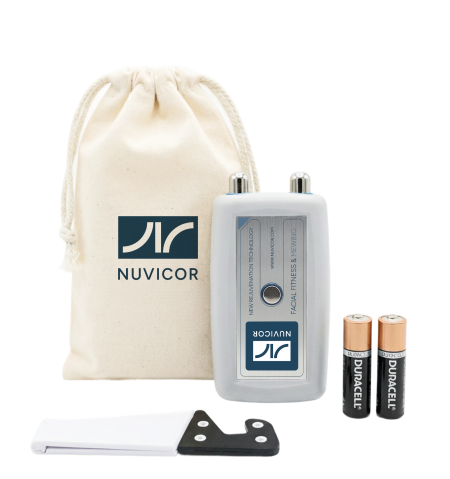
and tone. While we can easily train our body muscles at the gym using various fitness equipment, there was no such option for facial muscles—until recently. Now, that solution is here: Nuvicor.
and tone. While we can easily train our body muscles at the gym using various fitness equipment, there was no such option for facial muscles—until recently. Now, that solution is here: Nuvicor.